
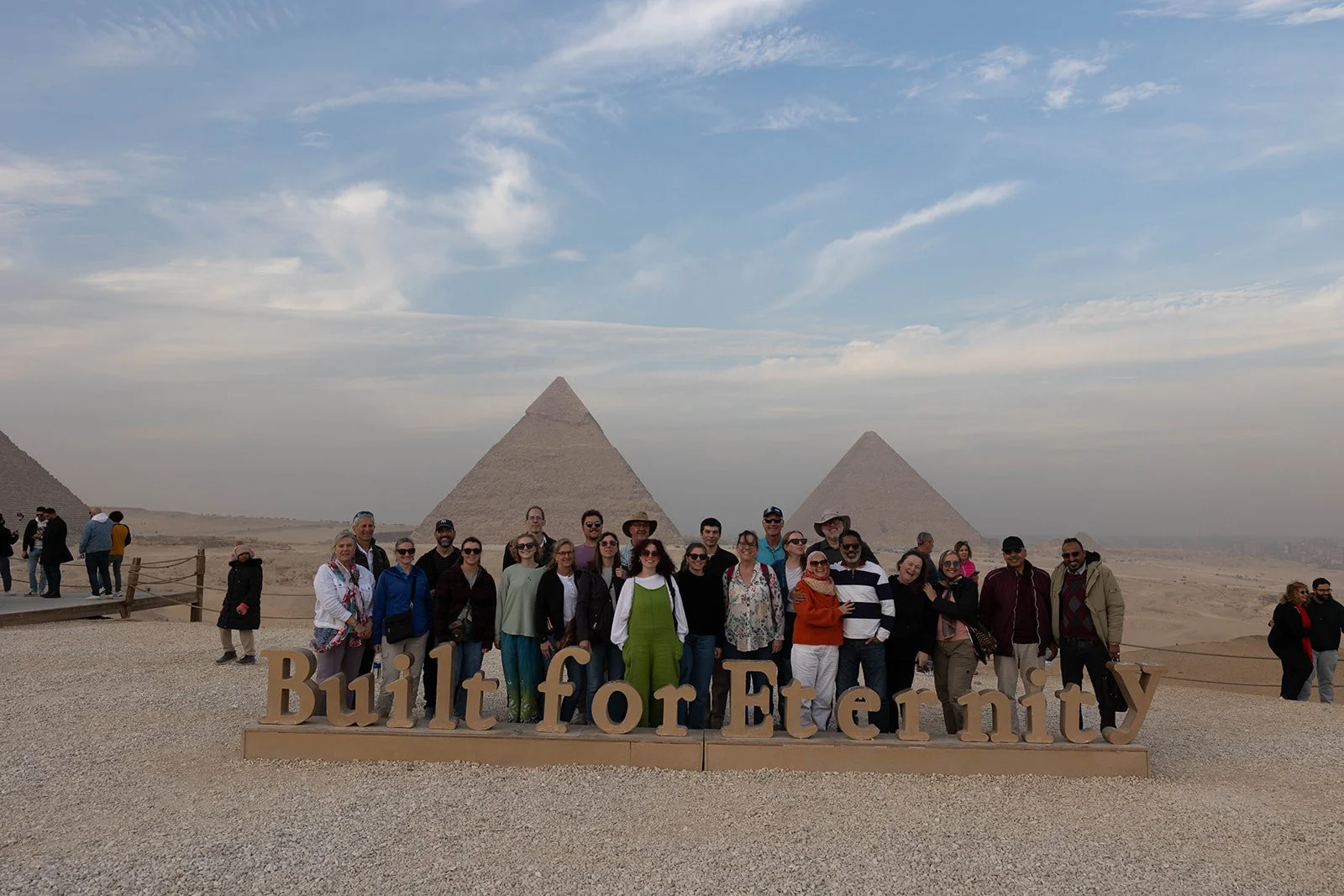
Some places remind you how brief a life is. Egypt reminds you what a life can build.
Here, the question of who you are becoming rises in the shadow of what was built to last.
Why Egypt?
-
Where Time Becomes a Threshold
For over five thousand years, human beings have stood on this land asking the same essential questions we are still asking today: Who are we? What outlives us? What is worth building? What does it mean to be accountable to something greater than ourselves? Empires rose and fell here. Faiths layered themselves over earlier faiths. Civilizations tested the limits of power, devotion, death, and continuity. Egypt holds not just monuments, but memory—of human striving across deep time.
And Egypt is not finished speaking. It is not frozen in its past. This is a living civilization still adjusting, responding, improvising—meeting modern pressures, global forces, spiritual questions, and social change in real time. To encounter Egypt now is to stand inside both inheritance and emergence at once. Personal stories widen. Individual struggles land inside a much older human arc that is still unfolding. Identity, purpose, and legacy stop feeling like abstract concepts and begin to carry moral weight. This is why Egypt transforms. Not because it dazzles—but because it remembers, adapts, and endures.
Egypt becomes a mirror for what is unfinished in us. Her scale invites perspective; her endurance invites humility; her presence invites a deeper kind of listening.
-
Egypt as Teacher, Not Commodity
Egypt is not offered here as something to be consumed. It is approached as a living teacher—complex, layered, dignified, and alive. This land carries its own rhythms, faith, struggles, celebrations, and contradictions. To enter Egypt with awareness is to enter a relationship, not a transaction. One comes not to project meaning onto it, but to be changed by encountering it as it is.
This is the difference between voyeuristic tourism and immersive presence. Voyeuristic travel looks without truly seeing. It moves across the surface. Immersive travel listens, lingers, and allows itself to be shaped by what it touches. In this work, Egypt is not a spiritual backdrop for personal reinvention; it is a living classroom where humility, witnessing, and mutual regard become part of the transformational path. What is learned here does not come from extraction—but from encounter.
To meet Egypt in this way is to practice a different kind of attention—one that acknowledges the land’s sovereignty and the depth of the lives unfolding within it. Transformation arises not from consuming meaning but from allowing context, culture, and encounter to reshape how one sees. Here, awakening is reciprocal: you witness Egypt, and Egypt, in turn, teaches you how to witness yourself.
-
Egypt and the Question of Legacy
Egypt is the most powerful legacy civilization the human family has ever built. It is impossible to stand before its temples, tombs, and monuments without feeling the weight of generational thinking—of lives shaped not only by what was needed in the present moment, but by what was meant to endure beyond it. This is a civilization that organized itself around continuity, remembrance, and the relationship between this life and what follows it.
For many women standing in her magnificence, this consciousness of legacy stirs something dormant and unnamed. Questions long held at the edges of awareness move to the center: What remains of me? What am I building that outlives my productivity? What kind of trace does my life leave in the human story? Egypt does not answer these questions for you—but it asks them with an authority that cannot be avoided. Here, legacy is no longer theoretical. It is architectural. It is spiritual. It is personal.
-
A Civilization Still Becoming
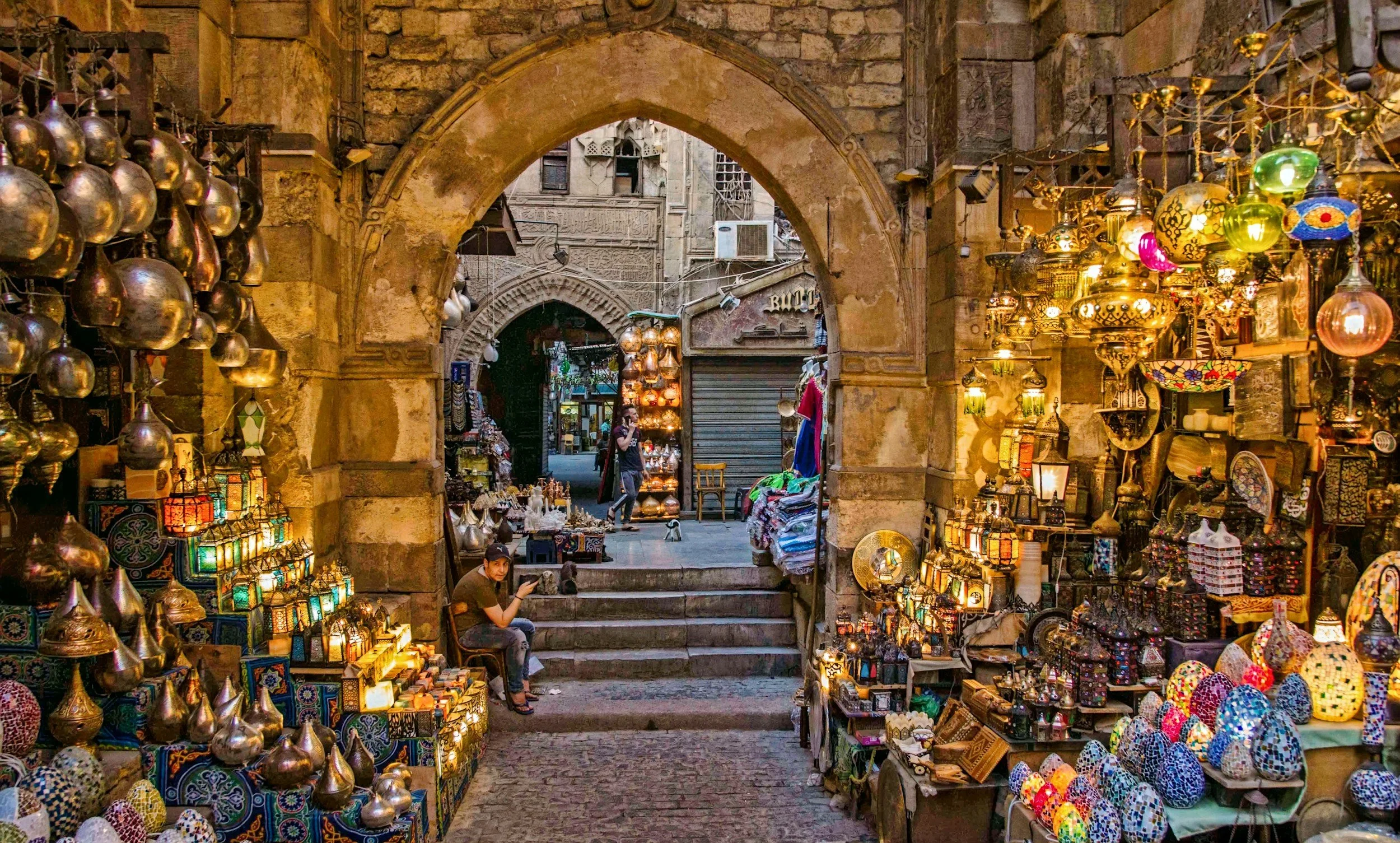
Egypt is not frozen in antiquity. It is a living, breathing society shaped by faith, family, ingenuity, struggle, laughter, constraint, and resilience. It is Muslim in its spiritual rhythms, urban and rural in its textures, youthful and ancient in its temperament. Children walk to school beneath minarets. Artisans throw clay on spinning wheels in village workshops. Calls to prayer ripple through traffic and tea shops alike. Ordinary life unfolds with extraordinary persistence.
To come to Egypt with awareness is to encounter real people—not symbols. Hospitality here is not performative; it is relational. Craft traditions are not souvenirs; they are livelihoods. Faith is not abstract; it structures time, ethics, rest, and daily bread. Economic realities are visible. So is joy. So is strain. This work does not invite you into a museum of ruins—it invites you into a living society. And it is precisely this encounter with modern, breathing Egypt that deepens what the ancient stones alone can never teach.
-
Why Egypt Matters Now
This is not a neutral moment in human history. Across the world there is exhaustion, disorientation, moral confusion, polarization, and spiritual fatigue. Many people feel unmoored—uncertain what to trust, where to stand, or how to live with integrity inside systems that feel unstable or unjust. The pace is relentless. The noise is constant. The soul grows tired.
And yet Egypt has lived through thousands of years of upheaval, collapse, renewal, conquest, revolution, continuity, and return. It carries the long memory of how civilizations unravel and how they endure. Its rhythms—of prayer, of family, of daily labor, of seasonal and sacred cycles—haven’t disappeared in the face of globalization; they have adapted. To come to Egypt now is not to escape the world’s fractures, but to stand inside a civilization that has learned how to live through them without losing its soul.
This is why Egypt matters for this moment. Not as a relic. Not as an answer. But as a living witness to endurance, sacred rhythm, and the possibility of coherence inside complexity. In times like these, the world does not need more spectacle. It needs steadiness, memory, humility, and the courage to keep becoming. Egypt still teaches those things—quietly, insistently, and with great tenderness.
-
What Egypt Asks of Us
Entering Egypt with awareness you see that transformation is not something delivered to you but something asked of you. Egypt does not invite passive awe. It calls for reciprocity—an orientation of humility, presence, and willingness to be shaped by encounter rather than spectacle. This land carries its own history, its own tensions, its own beauty and constraints. Entering it responsibly means acknowledging that we are guests inside a much larger story.
We are required to slowdown enough to see what is actually here: the labor behind the hospitality, the faith that structures daily life, the resilience embedded in ordinary rhythms, the creativity that emerges in the face of pressure. It means allowing modern Egypt—and not only its ancient stones—to reveal the textured, complex reality of a living civilization. In this way, Egypt becomes not a canvas for projection but a site of mutual regard.
Egypt teaches through relationship, through presence, through the subtle recalibration that comes when one stands inside continuity and contradiction at once. It asks us to listen more carefully, to widen our understanding of community, and to hold our own lives with a renewed sense of responsibility. The invitation is not to escape the world’s fractures, but to return to them more grounded, more discerning, and more attuned to what is worth building.